
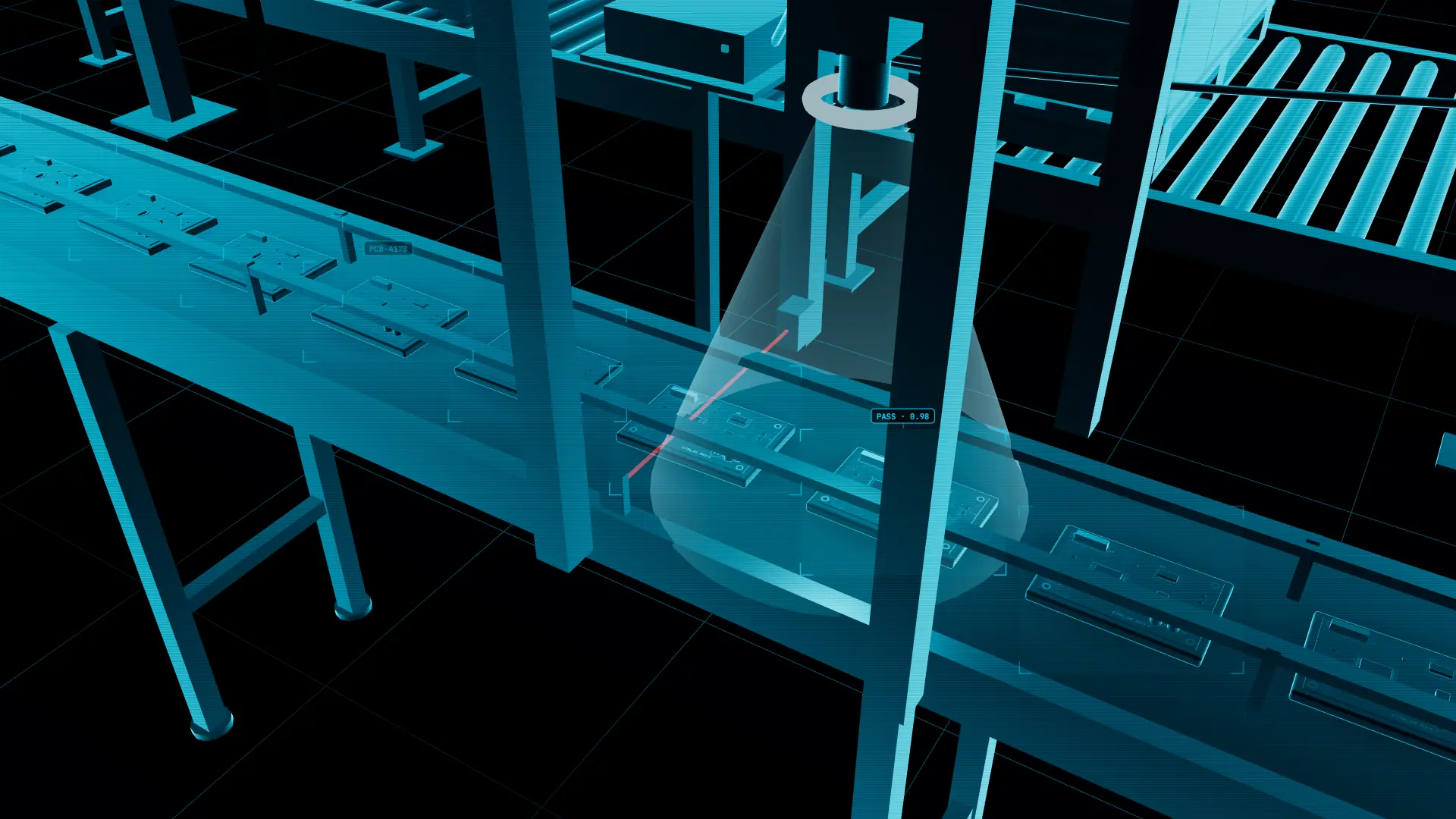
Custom AI vision models from the Industrial AI Vision Lab
The Vision Lab is where we develop product-specific vision models, trained on your products and the defects that matter to you, and validated before they reach the line.
Updated October 2026 · 3D simulation, illustrativeThe Industrial AI Vision Lab (VLab) is our model-training environment, where every Industrial AI Vision model is developed. Each model is product-specific: trained on images of your products and real defects from your Australian line, labelled to your quality team’s standards, and validated against your production footage before deployment.
- Learns your products, defects and standards
- Validated on footage it hasn’t seen
- Version-controlled, with every release recorded
- Edge deployment; images stay in your plant
- Improves as new examples come in
Why off-the-shelf models struggle on the line
They’re trained on public images, so they’ve never seen your product, your conditions or the faults you care about.
- 01
False alarms
Normal variation gets flagged as a fault, and operators learn to ignore the alerts.
- 02
Missed faults
The defects that matter to you were never in the training data.
- 03
Real plant conditions
Dust, steam, glare and night shifts throw off a model that has only seen clean photos.
How a product-specific model is developed
Collect
Good product, normal variation and real faults, photographed on your line if needed.
Label
Every image marked up to your quality team’s reject standards.
Train
Trained for the job, whether that’s finding a fault or sorting by grade.
Validate
Tested on images it has never seen, with catches, misses and false rejects reported.
Deploy
Commissioned on your line and signed off by your quality team before go-live.
Kept up to date as your products change
New products, packaging or defects become a new model version, developed and validated in the Vision Lab before release.
- Same test: every version checked against the same set of images
- Side by side: compared with the current version on catches, misses and false rejects
- Your sign-off: no update goes live without it
- Full history: every version recorded, with the previous one available if needed
- v3 Live
Added a new product and label design
Tested on the same photos before going live.
- v2 Previous
Added night-shift images and two new defect types
Retained as the previous version.
- v1 Archived
First model for the launch range
Archived with its test results.
Trained for the checks your operation needs
Packaging and labels
Labels, seals, date codes and pack damage, checked on every unit.
Food and beverage
Seals, labels, counts and contamination, trained for each product you run.
Manufacturing defects
Surface flaws, incomplete assemblies and wrong parts, caught before they ship.
Sorting and grading
Telling similar-looking products apart by the differences that matter for quality.
Machine status
Whether equipment is running, idle or stopped with a fault, read by camera.
Trucks and loads
Truck types and load checks, in dust, rain and darkness.
Runs at the edge and improves over time
Edge deployment means no per-image cloud fees, and the items it’s unsure about feed back into the Vision Lab to train the next version.
Edge AI vs cloud AIWhat we need from you
You don’t need a data team or a ready-made dataset.
Tip: keep a labelled box of real rejects, one bag per fault type.
- Examples of good product, including normal variation
- Real faults from the reject bin, for each fault type
- Line access at agreed times
- Someone from quality to say what counts as a reject
- Time to review the results before it goes live
Delivered as a working inspection system
Every Vision Lab model is delivered as part of a complete Industrial AI Vision system: cameras and lighting specified for the application, results passed to your plant’s control systems and reject equipment, and counts and reasons on your operator displays. See how plant integration works and production line inspection.
Why accuracy matters to operators
A system that raises false alarms soon gets bypassed. Training on your own product cuts false alarms and missed faults compared with a generic model in real plant conditions. Further reading: Custom-trained vs generic AI models and What is computer vision?
Frequently asked questions
Why do we need a custom model instead of an off-the-shelf one?
How many images do we need?
What if we don’t have any images yet?
How do we know it works before it goes live?
Can the model be retrained when our products change?
Who owns the model and our images?
Does the model need the internet or the cloud?
Read more about custom models
Talk to us about your product
Tell us what you make and which defects matter, and we’ll scope what a Vision Lab model would need.